
Quality Management System
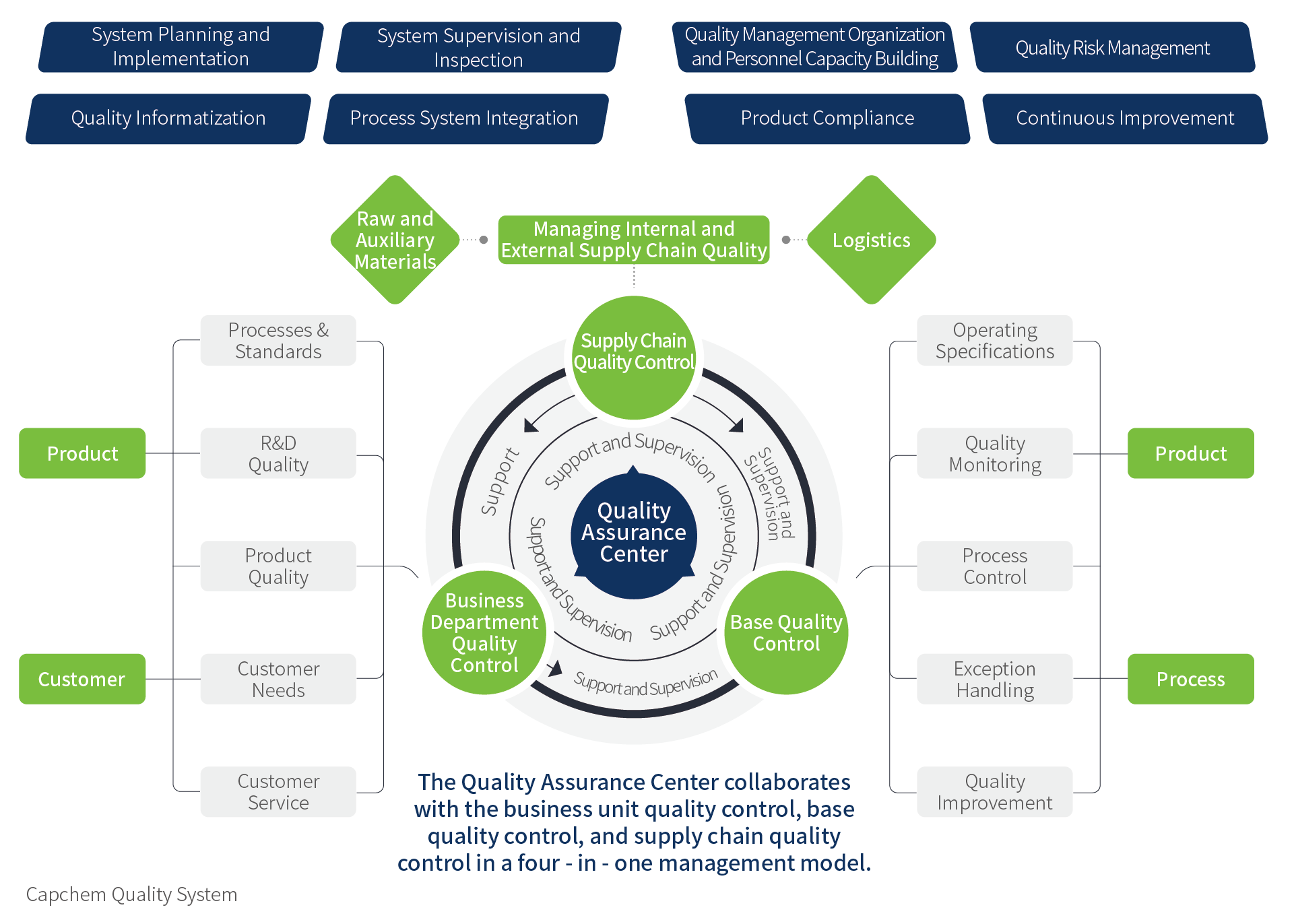
Capchem focuses on improving its quality management system to ensure efficient operations and management. The Company has established a quality management structure comprising the Quality Assurance Center, Business Department Quality Control, Quality Control in Supply Chain, and Base Quality Control, with clearly defined responsibilities and coordinated efforts to support and oversee quality management across the Company.
Capchem has established a comprehensive set of policies and procedures, including the Non-conforming Product Management Procedure, Internal Audit Management Procedure, Customer Quality Complaint Management Procedure, Regulation on Quality Incident Escalation and Accountability Management, Business Continuity Management Handbook, and BCM Business Continuity Management Procedures, enabling the Company to proactively respond to internal and external changes. In addition, Capchem continues to strengthen ESG management capabilities at its integrated management base by introducing the Responsible Business Alliance (RBA) Code of Conduct management system. This initiative enhances the Company's social responsibility management capabilities across labor practices, occupational health and safety, environmental protection, supply chain due diligence, and business ethics, further reinforcing Capchem's international competitiveness.
The Company continuously improves its quality system assessment mechanisms to achieve dynamic monitoring of quality management effectiveness. Key quality indicators, such as raw material pass rate, first-pass yield of finished products, and customer complaints, are established. Monthly or annual quality assessments are conducted, and responsible departments are required to analyze the causes of any underperformance and develop corrective action plans, continuously enhancing overall quality management.
Capchem actively promotes the digital transformation of product quality management by building a comprehensive information platform to achieve precise control over quality data across the full supply chain from suppliers to customers. The Company has deployed multiple information systems, including CRM, SRM, LIMS, MES, OA, and SAP, to construct a comprehensive digital quality management system. This system ensures product quality across multiple stages, including raw material control, dynamic monitoring of the production process, product inspection, and sales data analysis.
The Company follows ISO 9001 and IATF 16949 standards, conducting regular internal audits of its quality management system to evaluate compliance, adequacy, and effectiveness, with the aim of control the current state of the system and driving continuous improvement. Additionally, third party institutions are engaged for external audits. In 2025, the Company obtained multiple authoritative certifications, including ISO 9001 Quality Management System, IATF 16949 Automotive Quality Management System, QC 080000 Hazardous Substance Process Management System, and CNAS National Laboratory Management System.
Quality Management Enhancement
Capchem implements the whole process, full lifecycle quality management, covering six key dimensions: systems, R&D, production processes, suppliers, customer quality management, and continuous improvement. Through process optimization and technological innovation, the Company is committed to delivering high-quality products and services, driving robust operations and sustainable development across all business processes.
Quality Culture Development
To continuously enhance quality management effectiveness, the Company actively integrates internal and external resources, optimizes quality management training programs, and strengthens employees' theoretical knowledge and practical capabilities in product quality management. In 2025, Capchem conducted a series of quality management training programs covering quality improvement tools, operating standards, supplier quality management, and management system standards. These programs reached 13,650 participants, with total training hours of 44,173.03, averaging 3.24 hours per employee.
Highlights in 2025
- First-pass yield of finished products reached 99.88%, an increase of 0.38% from last year.
- Introduced the SRM system for systematic supplier management, improving raw material qualification rates from 96.8% to 97.83%.
- No major product quality incidents occurred.
- Quality management training covered 13,650 participants, with a total of 44,173.03 training hours.
Contact Us
Capchem Plaza, Changye Road, Pingshan District, Shenzhen City, China.


Channels

Capchem
online shop